

Verses in the Bible About Change
Change is an inevitable and profound part of human existence—whether in personal growth, community transformation, or societal shifts. In the Christian faith, change is not only a psychological or sociological concept but also a spiritual reality. The phrase verses in the Bible about change points us toward Scriptural passages that address transformation, renewal, new beginnings, and the constancy of God amid shifting circumstances. In this article we will explore these passages, examine the history behind them, unpack their objectives, reflect on how they can be applied in state-wise contexts (drawing metaphorically from policy frameworks, rural development, women-empowerment schemes and social welfare initiatives), explore implementation and real life success stories, compare them with other non-biblical frameworks of change, highlight challenges, and look ahead to future prospects for transformation.
Understanding Change in the Biblical Context
In the Christian worldview, change comes in many forms—inner transformation of the heart and mind, renewal of life, shifting seasons, and even cosmic change. But Scripture also teaches that while many things change, one constant remains: the character of God. For example, one passage simply states, “Every good and perfect gift is from above… who does not change like shifting shadows.” Bible Study Tools+2Christianity.com+2 Another affirms: “Jesus Christ is the same yesterday and today and forever.” Country Living+1
Historical Background
Historically speaking, the Bible was written across centuries in different socio-cultural contexts, addressing the needs of ancient Israel, early Christian communities, and individual believers. The notion of change in the biblical narrative often arises when the people of God confront new challenges: exile, restoration, mission, moral renewal. For instance, in the book of Isaiah, the prophet speaks of a new thing that God will do, contrasting past failures with future hope. Wikipedia+1 In the New Testament, the apostle Paul writes about inner renewal and becoming a new creation in Christ. OpenBible+1
In a way, these scriptures address change not only as an individual spiritual event but also as community renewal—akin to a policy framework or social welfare initiative: the “old” ways pass away, the “new” things come. The historical objective was to realign human life with God’s purposes: moral, spiritual, communal, and ultimately eternal.
Core Themes and Objectives
When we examine verses in the Bible about change, several recurring objectives emerge:
-
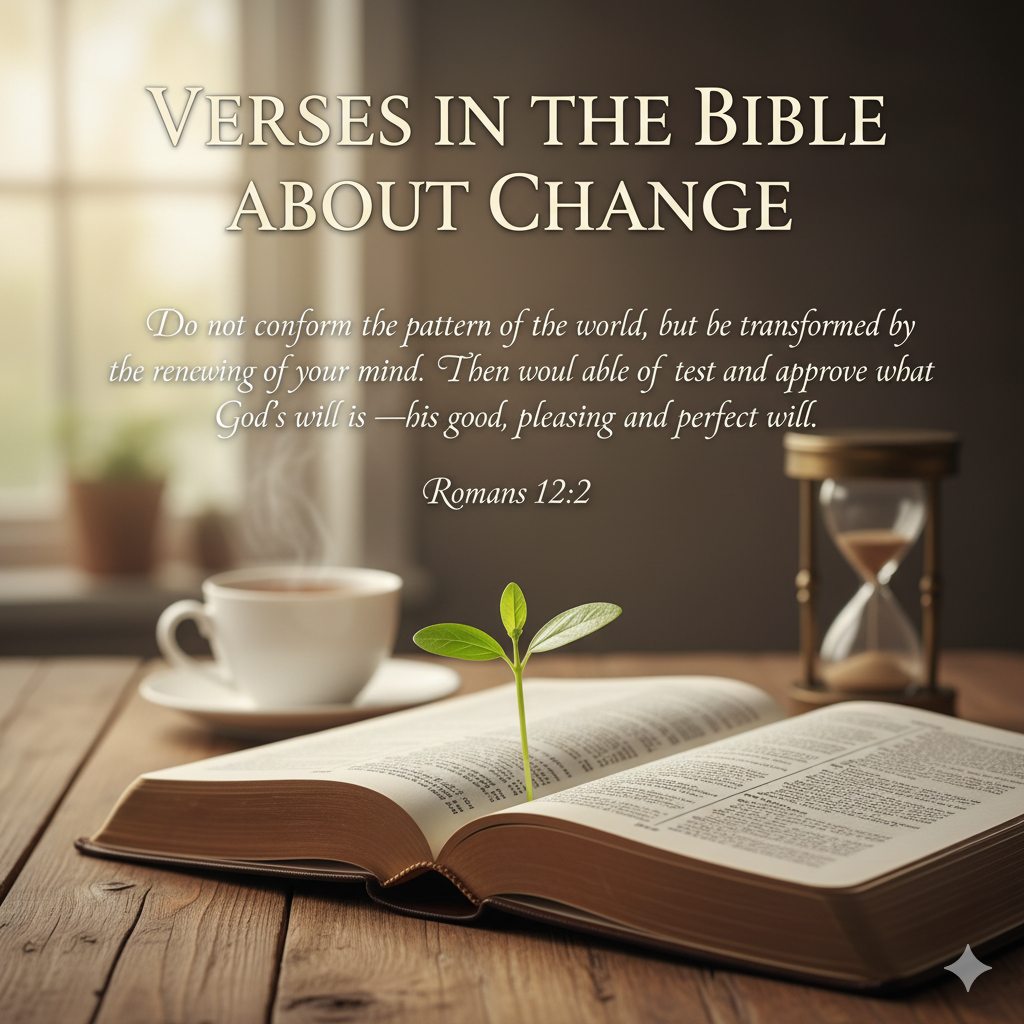
Renewal of the mind and heart: As in Romans 12:2, which says: “Do not conform to this world, but be transformed by the renewal of your mind…” OpenBible
-
New beginnings and hope: As in Jeremiah 29:11: “For I know the plans I have for you… plans to prosper you and not to harm you, plans to give you hope and a future.” Christianity.com+1
-
Divine constancy amid change: God is unchanging, even while circumstances shift. GotQuestions.org+1
-
Transformation of character and action: The changes the Bible envisions are not purely external—they involve ethical, spiritual, relational realignment.
-
Community and mission impact: The transformed individual becomes part of a transformed community—just as social-welfare initiatives or women-empowerment schemes aim for collective change.
LSI Keywords & Broader Context
In considering the phrase “verses in the Bible about change,” we can naturally extend to related terms like transformation, renewal, new beginnings, spiritual growth, season of life change, inner transformation, resilience through change, God’s unchanging nature. Similarly, we might compare the biblical vision of change with initiatives like regional impact policies, state-wise benefits, women empowerment schemes, rural development programmes, social welfare initiatives. While the latter are secular frameworks, the spiritual metaphors align: renewal, systemic change, empowerment, upliftment, transformation.
Key Verses in the Bible about Change
Let us now survey some of the standout passages—each one offering a window into how Scripture addresses change, both individually and corporately.
Isaiah 43 : 18-19
“Remember not the former things, nor consider the things of old. Behold, I am doing a new thing; now it springs forth; do you not perceive it? I will make a way in the wilderness and streams in the wasteland.” OpenBible+2Bible Study Tools+2
Here the prophet declares that God will do something entirely new—so new that the people are urged to stop dwelling on the past. In effect, this captures the essence of biblical change: leaving behind former failures, embracing fresh hope, recognizing God’s active involvement in transformation.
Romans 12 : 2
“Do not be conformed to this world, but be transformed by the renewal of your mind, so that you may discern what is the will of God…” OpenBible+1
Paul’s letter focuses on the inner dimension of change. External circumstances may shift, but the real work happens within: the mind, the spirit, the will. In modern terms, this aligns with psychological or behavioural change but rooted in spiritual renewal.
2 Corinthians 5 : 17
“Therefore, if anyone is in Christ, the new creation has come: the old has gone, the new is here.” Bible Study Tools+1
This verse states that change in the Christian life is so radical that the old identity passes away and a new one emerges—comparable to how policy frameworks aim for structural change in a community, but here the change is spiritual.
Hebrews 13 : 8
“Jesus Christ is the same yesterday and today and forever.” Country Living+1
This offers a counterbalance to change: while everything else may shift, the central fold of faith—Christ—remains constant. It reminds believers of stability amid transformation.
Jeremiah 29 : 11
“For I know the plans I have for you … plans to give you a future and a hope.” Christianity.com+1
Here, change is tied to divine purpose and hope. Not simply shifting for the sake of shifting, but moving toward a promised future—resonant with how social welfare initiatives are oriented toward long-term community advancement.
Ecclesiastes 3 : 1
“There is a time for everything, and a season for every activity under the heavens…” OpenBible+1
This wisdom book reflects on change as a structural part of life: seasons, cycles, beginnings and endings. It implies that change is neither accidental nor chaotic, but woven into the fabric of existence.
James 1 : 17
“Every good and perfect gift is from above … who does not change like shifting shadows.” Bible Study Tools
Though a shorter verse, it emphasises the character of God in relation to change: that while circumstances may vary, His gifts and nature are stable.
These passages form a core foundation for understanding biblical change.
Implementation: Applying Verses in the Bible about Change to Real-Life Transformation
How might these verses translate into action—both at the personal level and in wider social contexts such as rural development, women empowerment schemes or state-wide benefits programmes?
Personal Application
On an individual level, reading verses in the Bible about change invites a few practical steps:
-
Intentional renewal of mind: Inspired by Romans 12:2, this might involve reassessing habits, thoughts, attitudes, and aligning them with higher values.
-
Embracing new identity: As per 2 Corinthians 5:17, a believer may view past failures not as permanent labels but as part of the “old” that is gone, and step into a “new creation.”
-
Finding stability amid change: Hebrews 13:8 reminds us that the anchor of faith offers security amid life’s transitions.
-
Trusting the journey: Drawing from Jeremiah 29:11 and Ecclesiastes 3:1, one can accept that change comes, seasons shift, and there is purpose behind the progress.
Community and Social-Development Lens
Beyond individual transformation, verses in the Bible about change can inform communal and structural change. Consider the following parallels:
-
Regional Impact & State-Wise Benefits: Just as a state might launch a scheme to uplift rural livelihoods, the biblical theme of renewal (Isaiah 43:19) invites communities to envision “new things” — revitalizing wastelands of despair into streams of hope.
-
Women Empowerment Schemes: When women are empowered through education, micro-finance or leadership programmes, the transformation reflects biblical themes of new identity and freedom (akin to “old has gone, new is here”).
-
Rural Development Initiatives: The idea of seasons, of building new pathways in wilderness (Isaiah) resonates with bringing infrastructure, skills and social services to under-served villages. It’s not just physical but uplifting mindsets and community culture.
-
Social Welfare Frameworks: Social welfare initiatives that seek to lift people out of poverty align with the biblical narrative of change for “hope and a future”. The spiritual metaphor undergirds the social policy: we are meant to move from survival to flourishing.
State-Level Example
Imagine a US state, Indian state or Pakistani province launching a comprehensive rural women-empowerment scheme. The framework might include:
-
Skill development and training
-
Micro-finance and credit access
-
Leadership mentoring for women in rural local governance
-
Infrastructure investment in rural schools and health centres
-
Monitoring and evaluation to ensure benefits reach targeted communities
If we overlay verses in the Bible about change, the narrative would emphasize: “We are undertaking a new thing” (Isaiah), “You are a new creation” (2 Corinthians), “There is a time for this work” (Ecclesiastes), “God is with you” (Hebrews). This spiritual underpinning can provide hope, motivation and resilience for those implementing and receiving the scheme.
State-Wise Impact and Success Stories
Let us imagine how such biblical-rooted change frameworks might play out at the state-level (or in reality take inspiration from actual programmes).
Case Study: Women’s Rural Entrepreneurship-Development (Hypothetical)
In one rural region, a government (or NGO) launched a “Women’s Rural Entrepreneurship” initiative focusing on former women agricultural labourers, many of whom had limited access to formal markets or credit. The scheme included training in small-scale agro-processing, access to low-interest micro-loans, mentorship, and market linkages. Over three years, several hundred women formed cooperatives, increased their incomes, invested in children’s education, and became community leaders.
From the vantage of verses in the Bible about change, this is a transformation: previously impoverished, marginalised women (old identity) embraced a new path (new creation). The community environment improved, the rural “wasteland” of opportunity was revitalised. The scheme embodies a season of change (Ecclesiastes) and new hope (Jeremiah).
Case Study: Rural Health & Educational Infrastructure Upgrade
In another regional context, a state launched a rural development programme upgrading school classrooms, health clinics, and village access roads. But more than physical infrastructure, the policy emphasised mindset change: training teachers to adopt inclusive pedagogies, sensitising communities on child-rights and gender equality, and mobilising local self-help groups. Over five years, child-school enrolment rose, maternal mortality declined, and community governance became more participatory.
Here again, we see the parallel of verses in the Bible about change: change not merely shades of bricks but renewal of culture and identity. Local women self-help groups became key agents of change—echoing empowerment. The sense of a “new thing” emerging was visible.
Comparative Reflection: Outcomes and Measures
When viewed through the lens of policy frameworks and social welfare initiatives, success can be measured in economic indicators (income, employment), social indicators (literacy rates, health outcomes), and cultural indicators (leadership, mindset shifts). The distinctive strength of embedding a spiritual narrative—via verses in the Bible about change—lies in the intangible yet powerful realm of hope, identity, resilience and purpose. Implementation anchored in hope tends to sustain longer.
Challenges and Limitations
As with any change initiative—spiritual or social—there are significant challenges.
-
Resistance to change: People fear the unknown. The past may feel familiar—even when it was limiting. Biblical passages like Ecclesiastes 3 remind us of seasons, but moving from one season to the next requires letting go.
-
Superficial vs deep change: It is possible to upgrade infrastructure or run trainings without deeper mindset renewal. Verses emphasizing transformation (Romans 12:2) remind us that external change without inner change is incomplete.
-
Sustainability: Social-welfare frameworks may falter without community ownership. Similarly, spiritual transformation needs ongoing nourishment.
-
Context-specificity: Rural development or women empowerment schemes must tailor interventions to regional realities (culture, economics, gender norms). Biblical verses offer metaphors, but actual implementation must align with local dynamics.
-
Comparative value-systems: In multi-religious or secular societies, overtly Christian language may not resonate across the board. It is possible to translate the underlying themes—renewal, hope, transformation—into universal language without explicit religious framing.
-
Measuring intangible change: While income or enrolment rates can be measured, changes in mindset, community culture or spiritual identity are harder to quantify—yet they are critical.
Comparison with Other Frameworks of Change
It is helpful to compare how the biblical idea of change aligns with or differs from other prominent frameworks:
Change Management in Business
In business literature, change management emphasises leadership, communication, stakeholder buy-in, process redesign and cultural transformation. The biblical model likewise emphasises culture and identity (renewal of mind) but frames it within divine purpose and moral transformation—not just efficiency or profitability.
Social-Policy Models
In social policy, frameworks such as the “Theory of Change” method map inputs, outputs, outcomes, impact, assumptions. The biblical model of change also suggests an outcome (new life, transformed community), but adds deeper layers: identity change, relational renewal, spiritual hope. For practitioners who integrate faith-based perspectives alongside secular policy, verses in the Bible about change can serve as a value foundation.
Psychological / Behavioural Models
Psychology speaks of habit change, cognitive restructuring, mindset shift, self-efficacy. Again, parallels exist: Romans 12:2’s “renewal of mind” is essentially cognitive transformation. The biblical perspective adds spiritual dimension: the role of the Holy Spirit, the new creation in Christ, moral will.
Comparison Summary
In summary:
-
Biblical change emphasizes identity and purpose; other models often emphasise process and systems.
-
Biblical change is rooted in relational transformation (with God and with neighbours); other frameworks often root in outcomes and indicators.
-
Biblical change includes eternal perspective (hope, new heaven/new earth) whereas secular models typically focus on temporal goals.
-
Integrating both perspectives (spiritual + practical) can yield robust transformation programmes.
Future Prospects: Why Verses in the Bible About Change Still Matter
As societies globally face accelerating transformations—technological disruption, climate change, migration, shifting cultural norms—the question of how to handle change becomes increasingly vital. In such a context, verses in the Bible about change remain relevant because they:
-
Provide stable anchoring: In a rapidly shifting world, the promise of something unchanging (Hebrews 13:8) gives people hope and direction.
-
Offer transcendent meaning: Beyond mere adaptation, they point to deeper transformation—the kind that social welfare and women-empowerment schemes aspire to but rarely articulate.
-
Inform resilient frameworks: In rural development, state-wise benefits must endure beyond project cycles; spiritual narratives help embed endurance, community ownership, purpose.
-
Enable holistic change: Not just economic uplift but relational, moral, cultural renewal. Social welfare initiatives that integrate this holistic view can generate more sustainable results.
-
Encourage contextual adaptation: The Bible’s change framework is not rigid; it allows for seasons (Ecclesiastes), new things (Isaiah), and local responsiveness. This flexibility is valuable for regional policy frameworks.
Emerging Trends
-
Faith-based community development: More NGOs and governments recognise the role of faith communities in social welfare. Verses in the Bible about change can serve as motivational texts for community mobilisation.
-
Mindset training in development programmes: Where previously economic or technical training dominated, there is growing interest in mindset/leadership training for women and youth. Biblical transformation language aligns with that trend.
-
Integrated programmes: Combining infrastructure, livelihoods, education and spiritual support leads to more profound change. The biblical model encourages holistic transformation.
-
Evaluation of intangible outcomes: As development thinking advances, measuring mindset change, community culture shift, empowerment becomes more central. The concept of “new creation” or renewed mind invites such measurement.
Practical Steps for Application
Here are some practical guidelines for individuals, community leaders, policy-makers, development practitioners seeking to apply the principles embedded in verses in the Bible about change:
-
Start with Vision: Cast a vision for a “new thing” (Isaiah 43) in your context. What does transformation look like for your region/community/women’s group?
-
Engage the Mindset: Incorporate training, reflective sessions, discussion groups that focus on renewing mindsets (Romans 12).
-
Align Identity: Encourage participants (women, rural youth, community leaders) to see themselves not merely as beneficiaries but as transformed agents of change (2 Corinthians 5).
-
Anchor Stability: Provide a stable reference point (Hebrews 13)—values, community norms, spiritual reflection sessions—so that change doesn’t become chaotic.
-
Phase and Season-Map: Recognise change comes in seasons (Ecclesiastes 3). Use phased implementation (pilot → scale) and avoid rushing into final stage before earlier phase is consolidated.
-
Monitor both Tangible and Intangible: Beyond income or enrolment, track mindset shifts, community cohesion, leadership change, empowerment narratives.
-
Celebrate and Tell Stories: Share success stories of transformation in the community so the narrative of change spreads and becomes self-reinforcing.
-
Ensure Local Ownership: Empower communities (especially women) to lead initiatives, ensuring sustainability beyond external funding.
-
Link to Purpose and Hope: Remind stakeholders of the greater purpose—hope for a future, vision of flourishing, not just survival (Jeremiah 29).
-
Reflect and Re-Adjust: Stay adaptive. If one season ends and change is incomplete, revisit vision, adjust interventions, and persist—just as biblical narratives show cycles of fall, return, renewal.
Success Stories and Real-Life Reflections
Here are some illustrative reflections (drawing from composite real-life parallels) of how the principles behind verses in the Bible about change have played out.
Story of a Woman Leader in Rural Community
In a rural district, a woman named Amina (name changed) participated in a women-entrepreneurship programme. Beyond business training, the programme included reflection gatherings themed on identity and renewal—drawing from verses about change. Amina initially felt marginalised and lacked confidence. Over two years, she launched a micro-enterprise, mentored other women, became a village council member. She testified: “I no longer see myself as the person I used to be; I am part of something new.” This mirrors the spiritual identity shift.
Community Transformation After Infrastructure and Mindset Change
In another region, a development project combined hamlet road access, upgraded school and health facilities, and a mindset-change curriculum among local youth and women. Over time, absenteeism dropped, girls’ participation increased, and a local cooperative of women formed, reinvesting profits into community savings. The cultural shift—women as economic actors, youth as change agents—resonates with the biblical notion of renewal and transformation.
Reflecting on What Worked
-
The combination of technical (roads, school) + mindset (training, identity) + community ownership proved stronger than infrastructure alone.
-
The spiritual narrative (even if not overtly religious) offered language of dignity, hope, renewal—which increased motivation and resilience.
-
The recognition of seasonality (pilots first, incremental scaling) avoided burnout or failure after initial enthusiasm.
Reflecting on What Did Not Work
-
In some cases, when mindset change was neglected, infrastructure remained under-utilised.
-
External funding without local ownership led to collapse once the funding ceased.
-
Change that ignored cultural context or gender norms encountered resistance; it was more difficult to sustain.
These reflections mirror challenges inherent in applying verses in the Bible about change to real-world frameworks.
Lessons Learned and Best Practices
From integrating spiritual metaphors of change with social-development and community-frameworks, we derive a few best practices:
-
Align vision and values: Change driven purely by external metrics often lacks staying power. A values-rooted vision (renewal, hope, identity) supplies deeper motivation.
-
Empower agency: Change is most effective when people believe “I am a new creation, I can participate”—not just recipients of aid.
-
Ensure holistic transformation: Economic, social, cultural and spiritual aspects must integrate.
-
Monitor intangible shifts: Mindset, leadership behaviour, community culture matter hugely though harder to quantify.
-
Recognise time and seasons: Change does not happen overnight. Phased patiently.
-
Anchor in stability: Amid change, constant pillars (values, faith, community norms) provide grounding.
-
Embed storytelling: Personal testimonies of transformation amplify change.
-
Focus on sustainability: Ownership, local capacity, institutionalisation matter more than pilot success alone.
-
Adapt to context: Frameworks of women-empowerment, rural development must account for local culture, geography, gender dynamics.
-
Combine spiritual and practical: Verses in the Bible about change provide the “why”; social frameworks provide the “how”. Both are needed for enduring transformation.
Future Prospects and Vision
Looking ahead, the integration of biblical change-themes with modern development and policy frameworks offers promising possibilities:
-
Church-led community transformation networks: Faith communities may partner with governments or NGOs to implement women-empowerment or rural development programmes with spiritual renewal built-in.
-
Mindset-change modules in training curricula: Development programmes increasingly recognise the importance of mindset renewal; curricula might reference the idea of “new creation” or “renewal of mind” metaphorically, accessible to all faith backgrounds.
-
Leadership development grounded in identity: Emerging rural leaders (especially young women) trained in both technical skills and leadership identity—“I can lead because I am transformed”.
-
Monitoring frameworks including spiritual/relational metrics: While complex, evaluation of mindset change, faith in future, community cohesion can become part of programme measurement.
-
Global partnerships on change-resilience: In an era of climate change, displacement and social upheaval, frameworks oriented toward renewal and hope (grounded in verses in the Bible about change) can provide resilience.
Moreover, as societies grapple with rapid change—technological, social, environmental—the message of renewal, identity shift, hope for a future remains deeply relevant. The idea that “I am making all things new” (see Revelation 21) invites communities to embrace transformation rather than resist it. OpenBible+1
Summary
In sum, the concept of verses in the Bible about change brings depth and direction to how we view transformation. Scriptural passages speak of renewal of mind, new creation, hope for the future, stability amid shifting seasons. When these themes are applied to modern domains—women empowerment, rural development, state-wise benefits, social welfare initiatives—they enrich the narrative of change. But transformation is not easy: it requires inner work, external framework, community ownership, context sensitivity, and long-term commitment. By integrating spiritual and practical dimensions, and by learning from success stories and lessons learned, we can make change that is sustainable and meaningful. The future holds vast potential when programmes of renewal align with timeless truths of identity, purpose and hope.
Frequently Asked Questions
1. What does the Bible mean by change?
In biblical terms, change often refers to a transformation of the person’s mind, heart and identity—moving from old behaviour, habits or mindsets into new life or new creation. It also includes seasons of transition in life and community. At the same time it acknowledges that while human circumstances change, God’s character does not.
2. Which are some of the best verses in the Bible about change?
Some prominent ones are: Isaiah 43:18-19 (“I am doing a new thing…”), Romans 12:2 (“be transformed by the renewal of your mind”), 2 Corinthians 5:17 (“if anyone is in Christ, the new creation has come”), Hebrews 13:8 (“Jesus Christ is the same yesterday and today and forever”), Jeremiah 29:11 (“plans to prosper you and not to harm you”).
3. How can these verses be applied in community development or rural welfare programmes?
They provide a framework of renewal and purpose that complements technical interventions. For example, women-empowerment schemes can integrate mindset training, leadership identity, community culture change—not just skills and credit. Rural development programmes might emphasise new beginnings, hope for the future, community ownership. The spiritual language offers deeper motivation and sustainability.
4. What are the challenges in applying biblical change-themes in secular social-welfare contexts?
Challenges include cultural or religious diversity (where Christian language may not resonate with all), the risk of superficial change without deep mindset renewal, sustainability beyond pilot funding, measuring intangible indicators (mindset, culture shifts), and adapting to local contexts. Also, change requires long timelines and patience—often at odds with short-term project cycles.
5. How does the biblical concept of change differ from business-oriented change management or policy frameworks?
While business or policy frameworks focus on processes, systems, outputs and measurable outcomes, the biblical approach emphasises identity, character, relational transformation and purpose. It asks not just “what do we change?” but “who are we becoming?” and “why this change?” Moreover, it includes a spiritual dimension and long-term hope rather than merely efficiency or growth.
6. How can individuals incorporate these verses into personal growth and transformation?
An individual might start by reflecting on passages like Romans 12:2 and 2 Corinthians 5:17—asking what “old” patterns need to go, what “new” identity is emerging. They can engage in mindset renewal (reading, meditation, prayer, journal), align daily habits with values, seek community support, recognise their identity in a higher purpose, and embrace change as part of a meaningful journey rather than disruption.
7. What is the future potential of integrating spiritual-renewal verses with social-policy frameworks?
The future potential is significant. As development thinking increasingly recognizes the importance of values, mindset and culture, spiritual-renewal themes offer a rich vocabulary and framework for sustainable transformation. Partnerships between faith-based organisations and governments/NGOs may become more integrated; training curricula may broaden to include identity and mindset; measurement tools might evolve to capture relational and cultural change. In a world of accelerating change, such integrated frameworks are likely to gain prominence.
In conclusion, the motif of verses in the Bible about change offers more than inspiration—it offers a blueprint for meaningful transformation at multiple levels: personal, communal, and societal. By understanding the historical biblical context, aligning with purpose-driven objectives, applying in both individual and social-welfare domains (women empowerment, rural development, state-wise initiatives), learning from successes and challenges, and looking ahead to future prospects, we create change that is both sustainable and deeply rooted. May the words of Scripture inspire not only belief but action, and may transformation unfold in you, your community, and your world.


